

Achieving fruit with good calibre, firmness, uniformity and adequate quality is one of the main objectives during the final stages of the production cycle. However, the final result does not depend solely on supplying nutrients: photosynthetic activity, photoassimilate transport, water balance and the plant’s capacity to respond to stress situations also play an important role.
In this context, seaweed extracts have become a tool of great interest within plant nutrition programmes. Their value does not lie in replacing conventional fertilisation, but in complementing it and helping the plant maintain efficient physiological activity during particularly demanding periods, such as fruit enlargement and ripening.
What do seaweed extracts provide to crops?
Seaweed extracts contain different bioactive compounds, whose presence and concentration depend on the species used and the extraction process. These may include polysaccharides, phenolic compounds, mannitol, amino acids, micronutrients and other molecules with biostimulant activity.
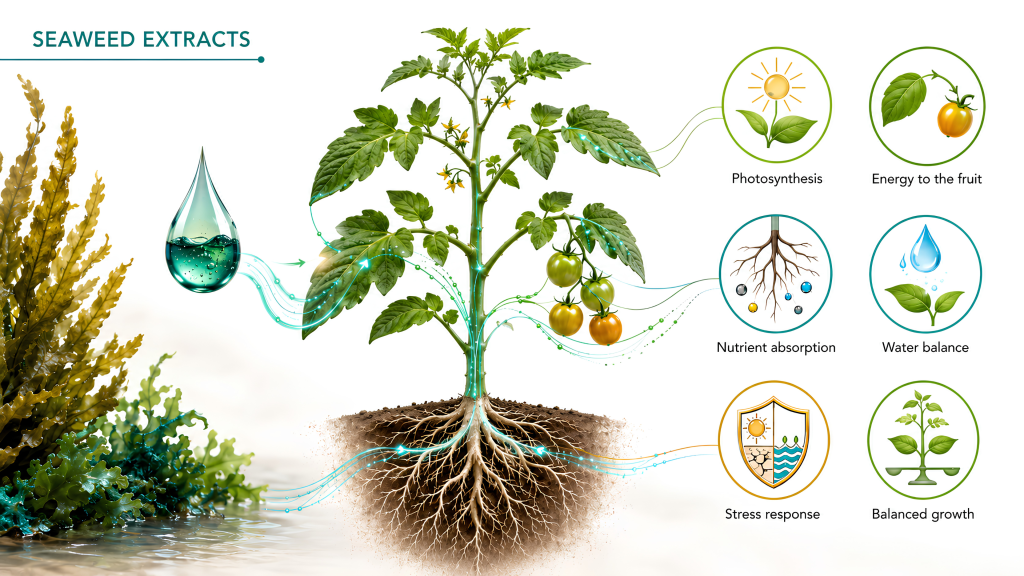
In agriculture, their application is mainly associated with the stimulation of different physiological processes in the plant, such as:
- Metabolic and photosynthetic activity.
• Nutrient absorption and utilisation.
• Mobilisation of photoassimilates towards growing organs.
• Regulation of water balance.
• Response to heat, drought, salinity or other stress situations.
• Maintenance of balanced vegetative activity.
These actions are particularly interesting during fruit development, a stage in which the demand for water, energy and nutrients increases considerably.
Fruit enlargement: a high-demand stage
During fruit enlargement, intense cell division and expansion take place. For this process to develop correctly, the plant needs to maintain good photosynthetic activity and transport sugars, water and nutrients generated or absorbed by other organs towards the fruit.
The fruit acts as an important sink organ. This means that it competes for available resources with shoots, roots and other fruits. When the plant suffers stress or presents nutritional imbalances, the production and transport of these resources may be limited, affecting calibre, uniformity and the final quality of the harvest.
Seaweed extracts can help maintain the plant’s physiological activity during this period. They do not cause fruit size to increase by themselves, but they can favour the necessary conditions for the crop to make better use of the available water and nutrients.
Support against stress during fruit development
The fruit enlargement and ripening stages often coincide with periods of high temperatures, high solar radiation or greater water demand. These conditions can reduce photosynthesis, alter cell membrane function and hinder nutrient transport.
Certain compounds present in seaweed extracts can help the plant manage these situations. Their biostimulant action contributes to maintaining physiological balance and favours faster recovery after stress episodes.
This can indirectly translate into greater continuity in fruit development and a lower loss of productive potential. In any case, their efficacy will depend on the condition of the crop, the timing of application, environmental conditions and the presence of correctly balanced base nutrition.
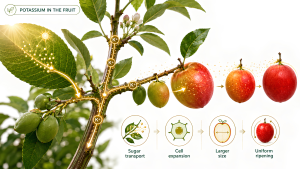
Potassium: sugar transport, calibre and ripening
Potassium plays a fundamental role during fruit formation and enlargement. Its functions include regulating stomatal opening and closure, water balance, activation of numerous enzymes and transport of sugars from the leaves to storage organs.
Adequate potassium availability can contribute to:
- Favouring the movement of photoassimilates towards the fruit.
• Maintaining turgor and cell expansion.
• Supporting calibre development.
• Improving sugar accumulation.
• Favouring more uniform ripening.
• Contributing to colour and certain organoleptic characteristics.
For this reason, potassium becomes especially important during fruit enlargement and ripening stages. However, its supply must be adjusted to the real needs of the crop, as excesses can interfere with the absorption of other elements such as calcium or magnesium.
Calcium: structure, firmness and storage capacity
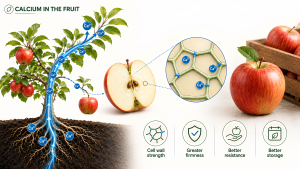
Calcium is another essential element for fruit quality. It forms part of cell walls and contributes to membrane stability, helping maintain the cohesion and resistance of plant tissues.
Correct calcium nutrition is associated with:
- Greater fruit firmness.
• Better mechanical resistance of tissues.
• Lower sensitivity to certain physiological disorders.
• Better performance during handling and transport.
• Greater storage capacity after harvest.
Calcium mobility within the plant is limited and depends largely on water flow through the xylem. In addition, leaves and young shoots can compete with fruits for this nutrient. For this reason, its management must begin from early stages and be maintained throughout crop development, rather than waiting only until the weeks before harvest.
Amino acids as metabolic support
Amino acids are the basic components of proteins and participate in numerous metabolic processes. Although the plant can synthesise them by itself, their external supply can be interesting during periods of high energy demand or after a stress situation.
During fruit development, amino acids can complement the action of seaweed and mineral nutrients by favouring metabolic activity and helping the plant maintain its physiological functions.
Their application does not replace complete mineral nutrition, but it can contribute to improving crop response when used within a well-planned strategy.
The importance of combining biostimulation and nutrition
The final quality of a fruit depends on multiple factors. For this reason, the best results are usually obtained through programmes that integrate biostimulation with specific nutrition for each phenological stage.
The combination of seaweed extracts, amino acids, potassium and calcium is particularly interesting during fruit enlargement and pre-ripening stages. Each component acts through a different function:
- Seaweed supports physiological activity and stress response.
• Amino acids complement plant metabolism.
• Potassium participates in water balance and sugar transport.
• Calcium reinforces tissue structure and firmness.
The synergy between these components makes it possible to address aspects related to size, uniformity, firmness and the commercial quality of fruits together.
Binat Super-E: specific nutrition for the final stages
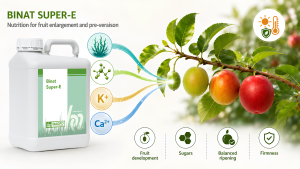
Following this approach, Binat Super-E is a liquid fertiliser formulated with seaweed extract and amino acids, enriched with potassium and calcium. Its components are synergised to exert a combined action on fruit nutrition during fruit enlargement and pre-veraison stages.
Its formulation seeks to support the crop at a time of high demand, combining the biostimulant effect of seaweed with nutrients closely related to fruit development, ripening and consistency.
Binat Super-E can be integrated into nutritional programmes aimed at:
- Supporting fruit development and filling.
• Favouring sugar transport and accumulation.
• Contributing to more balanced ripening.
• Improving tissue firmness and quality.
• Helping the plant maintain its activity under stress conditions.
Its use must always be adapted to the type of crop, phenological stage, crop load and the specific conditions of the plot.
A strategy for producing higher-quality fruit
Seaweed extracts represent a valuable tool for complementing crop nutrition during the most demanding stages. Their capacity to support physiological activity, improve stress response and favour nutrient utilisation makes them an interesting ally during fruit enlargement and ripening.
When combined with elements such as potassium and calcium, as well as amino acids, it is possible to develop a more complete strategy to support the formation of fruits with good calibre, greater firmness, uniform ripening and better commercial characteristics.
The objective is not only to produce more, but to help the plant transform its resources more effectively into quality fruit.
Productos relacionados