

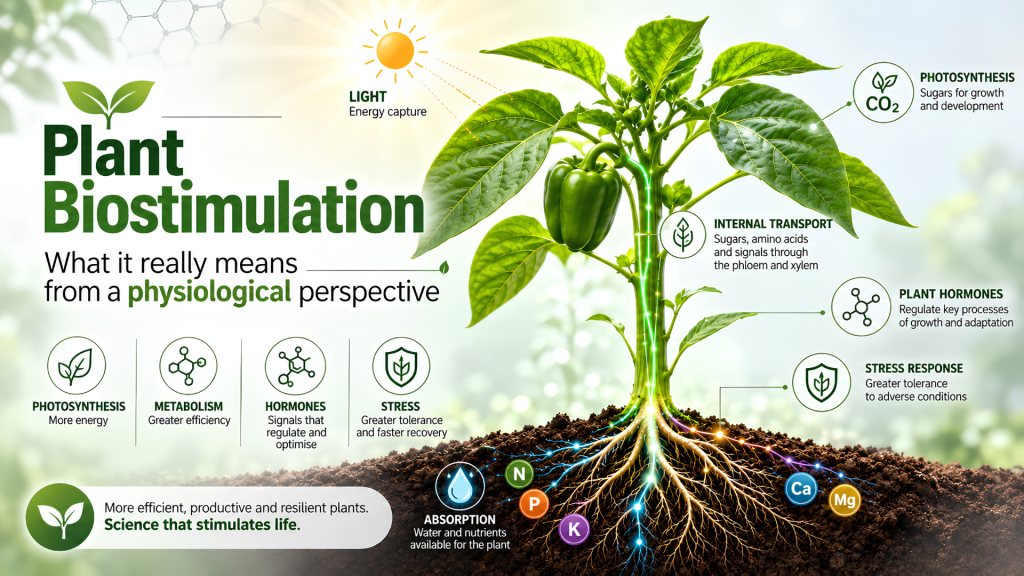
In agriculture, the term plant biostimulation is often used to refer to products capable of improving crop development, increasing tolerance to stress or favouring nutrient utilisation. However, to understand what it really means to biostimulate a plant, it is necessary to look at what happens inside it.
A plant does not grow simply because it receives water, light and fertilisers. To transform these resources into roots, leaves, flowers or fruit, it must activate and coordinate thousands of metabolic reactions. It absorbs nutrients, transports them between organs, manufactures sugars, produces proteins, regulates its water balance and continuously modifies its metabolism according to environmental conditions.
From a physiological perspective, biostimulation means favouring the efficiency of these processes, helping the plant to use its own resources better and respond in a more balanced way to the demands of the crop.
The plant as a network of connected processes
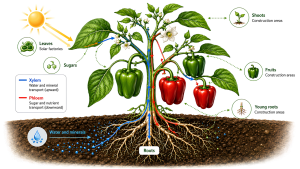
We can imagine a plant as a functioning city.
The roots represent the entry points for water and nutrients. The xylem and phloem act as a network of internal roads. The leaves function as solar factories capable of producing sugars, while the fruit, shoots and young roots are construction zones that constantly demand energy and materials.
For this city to function properly, it is not enough to have raw materials available. Transport must also be efficient, the factories must have energy, there must be communication between the different organs and the plant must be able to react when a stress situation occurs.
Biostimulation acts precisely on this coordination capacity. It does not replace mineral nutrition, nor does it always supply large quantities of nutrients. Its main function is to improve the plant’s physiological response, making it easier for certain processes to develop more efficiently.
Activation of plant metabolism
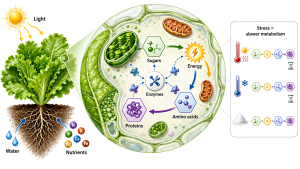
Plant metabolism consists of the set of chemical reactions that allow the plant to stay alive and grow.
Inside each cell, transformations are constantly taking place: sugars are used to obtain energy, nitrogen is incorporated into amino acids, amino acids form proteins and numerous compounds act as signals, pigments, antioxidants or cellular structures.
These reactions are directed by enzymes. We can visualise enzymes as small specialised tools. Each one participates in a specific task: joining molecules, breaking them apart, transforming them or transferring energy.
When enzymatic activity is adequate, metabolism functions smoothly. When the plant is subjected to cold, heat, salinity, lack of water or nutritional imbalances, many of these reactions slow down.
Certain biostimulant substances can favour metabolic activity directly or indirectly. Some compounds provide precursors that the plant can use to manufacture new molecules. Others participate in enzyme regulation, membrane stability or protection against oxidative damage.
The aim is not to force the plant to grow, but to help it maintain the functioning of its essential processes.
Nutrient absorption and utilisation
One of the most important effects of biostimulation is related to plant nutrition.
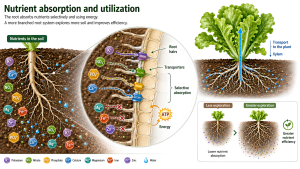
The presence of a nutrient in the soil does not guarantee that the plant can absorb it. The element must be available, come into contact with the root, cross its tissues and be transported to the organ where it is needed.
The root does not function like a simple straw that indiscriminately absorbs everything it finds. It is a highly selective structure.
On the surface of the roots there are transporter proteins that act as entry gates. Some allow the passage of potassium, others nitrate, phosphate, iron or different micronutrients. For these gates to function, the plant needs energy and suitable conditions around the root.
Biostimulants can help improve this process by favouring root growth, increasing the formation of absorbent hairs or stimulating the metabolic activity of root cells.
A more branched root system can explore a greater volume of soil. It is similar to expanding a company’s collection network: the larger the area covered, the greater the chances of locating water and nutrients.
Nutritional efficiency can also be improved. This means that the plant is able to produce more biomass or better maintain its activity by using the available nutrients more effectively.
The role of roots and the rhizosphere
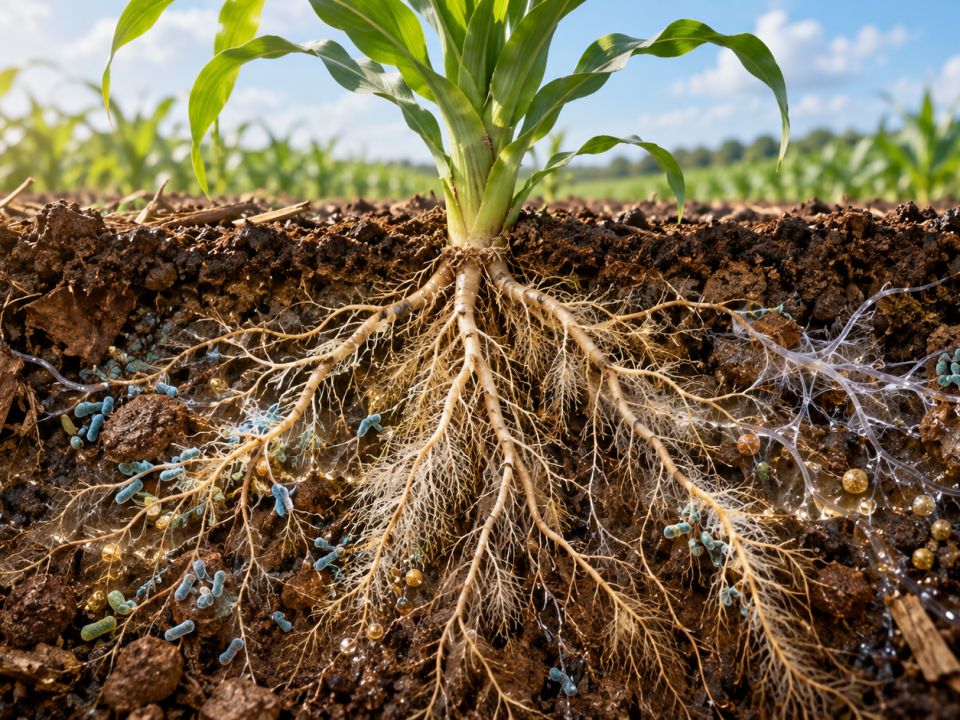
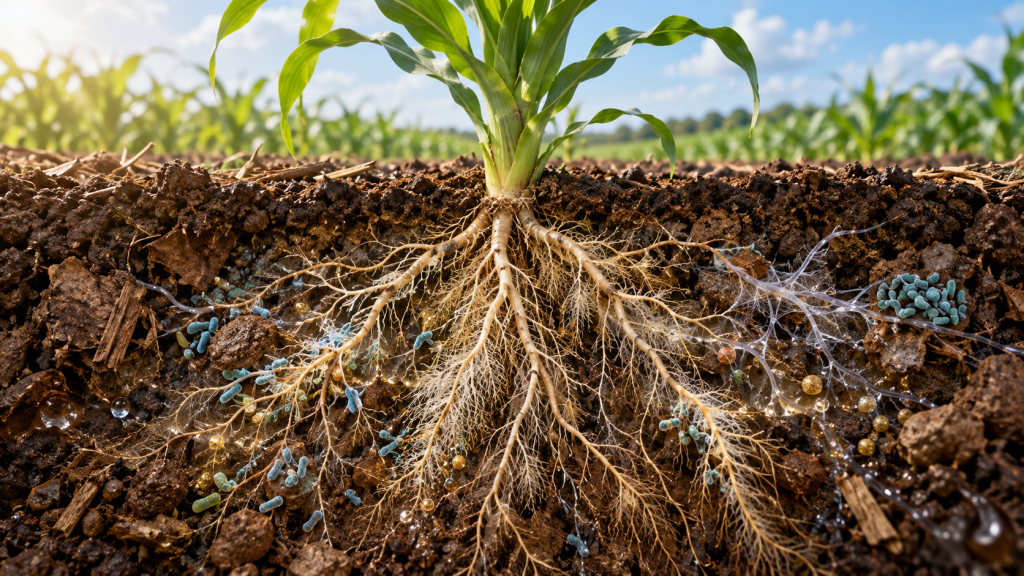
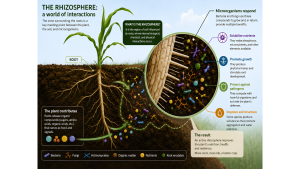
The zone that directly surrounds the roots is called the rhizosphere. Although it occupies only a few millimetres, it is one of the most active regions of the soil.
Roots release sugars, amino acids, organic acids and other substances. These compounds serve as food and signals for numerous microorganisms.
We can imagine the rhizosphere as a microscopic market. The plant delivers part of the carbon it manufactures in the leaves and, in exchange, certain microorganisms help solubilise nutrients, produce metabolites or compete with harmful organisms.
Some biostimulants act by favouring this interaction between the plant, the soil and microorganisms. Others directly stimulate the development of lateral roots or the formation of root hairs.
A more efficient root architecture not only improves absorption. It also allows the plant to anchor itself better, explore deeper soil layers and maintain the water supply for longer when conditions become unfavourable.
Photosynthesis and energy production
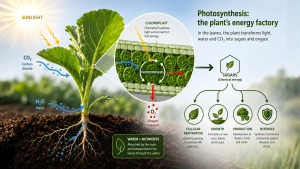
Photosynthesis is the process by which the plant uses light to transform carbon dioxide and water into organic compounds.
Visually, each leaf functions like a solar panel made up of millions of small capture units. Inside its cells are chloroplasts, organelles rich in chlorophyll where light energy is transformed into chemical energy.
The sugars produced during photosynthesis are not only used to form fruit. They also serve to maintain cellular respiration, manufacture cell walls, develop new roots, produce proteins and synthesise defence molecules.
When a plant suffers stress, photosynthesis usually decreases. The stomata may close to prevent water loss, less carbon dioxide enters and sugar production is reduced.
At the same time, the plant may need more energy to repair damage and maintain its defence systems. It is as if a factory reduced its production precisely when maintenance costs increase.
Biostimulation can help preserve photosynthetic activity, improve pigment stability or favour the balance between energy production and consumption.
Hormonal regulation and growth
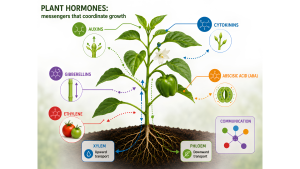
Plant development is coordinated by chemical signals known as phytohormones.
Auxins participate in growth and root formation. Cytokinins are involved in cell division and the development of new tissues. Gibberellins are related to elongation and certain reproductive processes. Abscisic acid plays an essential role in drought response, while ethylene is involved in ripening, senescence and various stress responses.
These hormones do not act in isolation. They function as a network of messages that informs each organ about what is happening in the rest of the plant.
For example, when the roots detect a lack of water, they can send signals towards the leaves. In response, the stomata partially close to reduce transpiration.
Some biostimulants can influence these signalling pathways. Not always because they contain hormones, but because they provide compounds capable of modifying their synthesis, degradation or perception.
Biostimulating growth does not simply mean increasing a hormone. The real objective is to favour a hormonal balance adapted to the crop stage.
Cell division and tissue expansion
The growth of a leaf, root or fruit depends on two main processes: cell division and cell expansion.
During division, one cell duplicates and gives rise to two new cells. Later, these cells absorb water, accumulate solutes and increase in size.
We can compare fruit development to the construction of a building. In the first stage, new rooms are created. In the second, those rooms are enlarged and filled.
Cell division requires energy, proteins, nucleic acids and new membranes. Expansion requires water, cell wall elasticity and adequate osmotic regulation.
Biostimulation can favour these processes by improving energy availability, protein synthesis, water status or enzymatic activity. However, the effect depends on the plant having nutrients and minimally suitable environmental conditions available.
Biostimulation and stress response
One of the most relevant areas of plant biostimulation is tolerance to abiotic stress.
Heat, drought, cold, salinity and excessive radiation can alter membranes, denature proteins, reduce photosynthesis and cause the accumulation of reactive oxygen species.
These reactive molecules are produced naturally during metabolism. In small quantities, they participate in cellular signalling. The problem appears when their production exceeds the plant’s control capacity.
We can visualise them as small metabolic sparks. Under normal conditions, they are quickly extinguished by antioxidant systems. During intense stress, too many sparks are generated and they can begin to damage membranes, pigments and proteins.
The plant has antioxidant enzymes and protective compounds capable of neutralising them. In addition, it can accumulate proline, soluble sugars and other osmoprotective molecules that help maintain hydration and cellular stability.
Certain biostimulant strategies favour these defences, preparing the plant to respond more quickly or helping it recover after the stress episode.
This does not mean that the crop becomes invulnerable. A biostimulant does not eliminate drought, reduce environmental temperature or correct extreme salinity by itself. Its function is to widen the physiological margin within which the plant can continue functioning.
The importance of application timing
The response to a biostimulant depends largely on the physiological status of the crop.
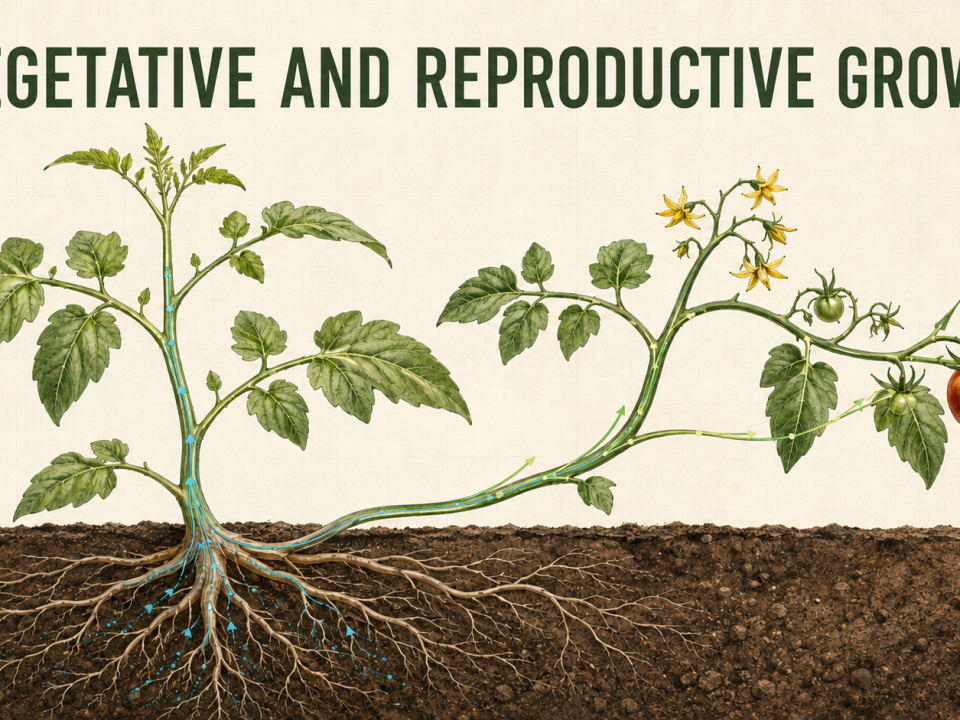
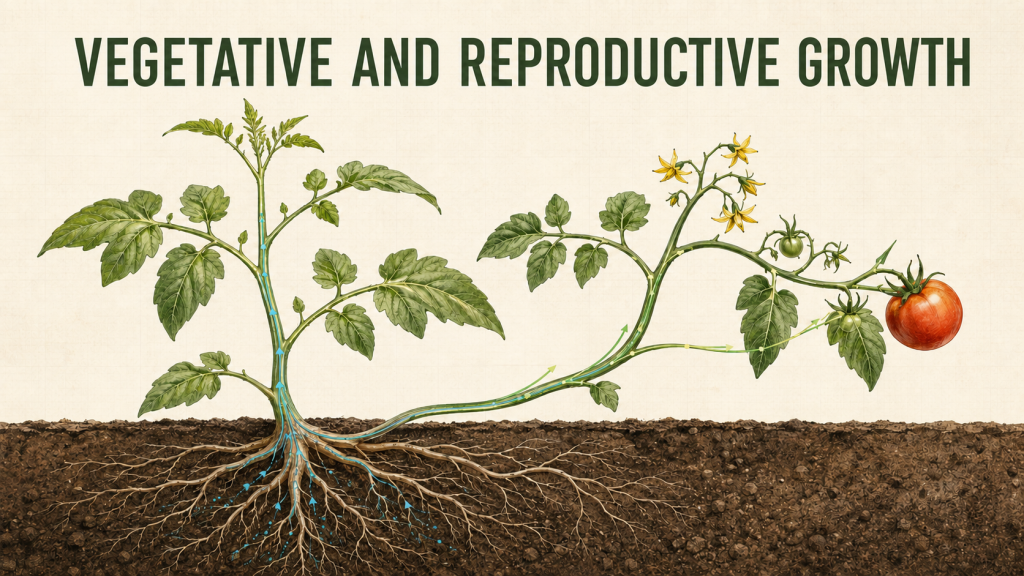
A young plant in the rooting stage does not have the same needs as a plant in flowering or a crop in full fruit filling.
During establishment, it is important to favour root activity and the formation of new tissues. In pre-flowering, it may be important to ensure energy, nutrient transport and hormonal balance. During fruit set and fruit expansion, sugar movement, water regulation and the availability of certain nutrients become more relevant.
For this reason, biostimulation should be understood as a tool integrated into agronomic management, not as an isolated application.
The product, rate, timing and application method must be chosen according to the physiological objective.
Biostimulation is not over-fertilisation
One of the most common mistakes is to confuse biostimulation with fertilisation.
Fertilisers supply essential nutrients. Biostimulants mainly act by improving processes related to absorption, metabolism, growth or stress response.
Both strategies can complement each other, but they are not equivalent.
A plant with a severe nitrogen deficiency needs nitrogen. Biostimulation cannot manufacture an element that is not present. Similarly, applying more fertiliser does not always solve a physiological limitation if the roots are damaged, the soil is saturated with water or metabolism is blocked by stress.
The key is to distinguish between resource availability and the capacity to use those resources.
A tool to improve physiological efficiency
From the perspective of plant physiology, biostimulation can be defined as the set of interventions aimed at improving the plant’s capacity to capture resources, transform them, transport them and use them efficiently.
Its action may be reflected in greater root activity, better water balance, more stable photosynthesis, faster recovery after stress or more efficient distribution of nutrients and sugars.
The visible result may be a more uniform crop, better flowering, greater fruit set or fruits with better calibre. However, these external effects are the final consequence of changes that begin much earlier, at cellular and metabolic scale.
Understanding biostimulation from this perspective allows it to be used with greater precision. It is not simply a question of applying a product so that the plant grows more, but of identifying which physiological process needs support and at what moment.
Ultimately, biostimulating a plant means helping it do better what it already knows how to do: capture energy, organise its resources, adapt to the environment and transform its metabolism into growth and production.
Productos relacionados