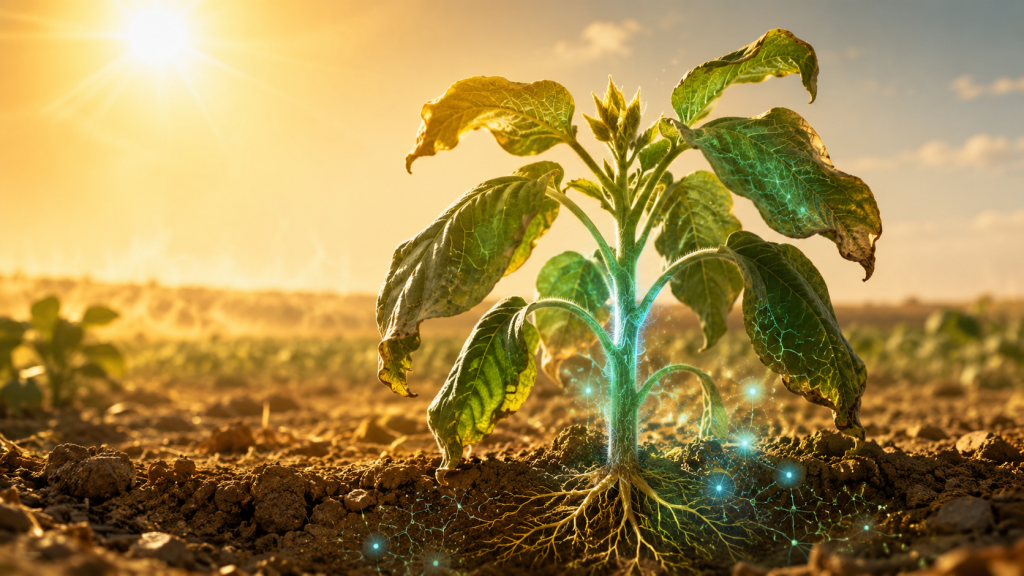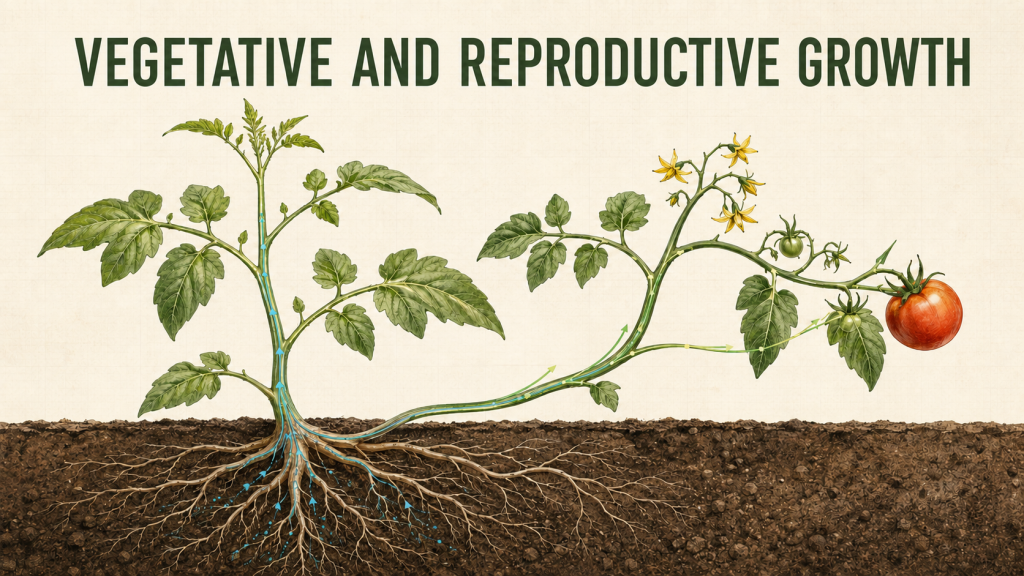


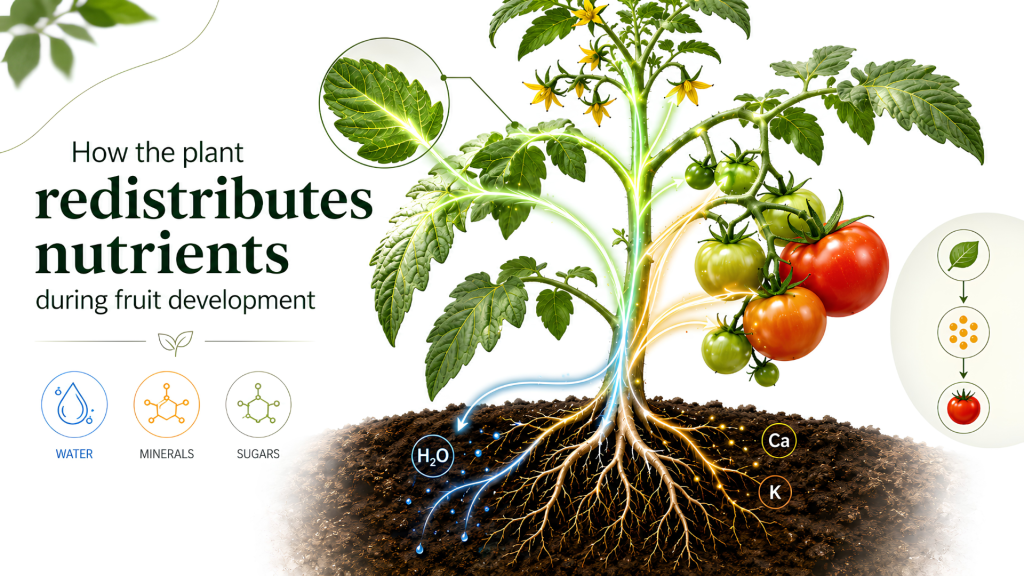
The development of a fruit does not depend solely on the nutrients that the plant absorbs from the soil at that particular moment. In order for a newly fertilised flower to become a fruit with good calibre, uniformity and adequate composition, the plant must organise a complex internal transport and redistribution network.
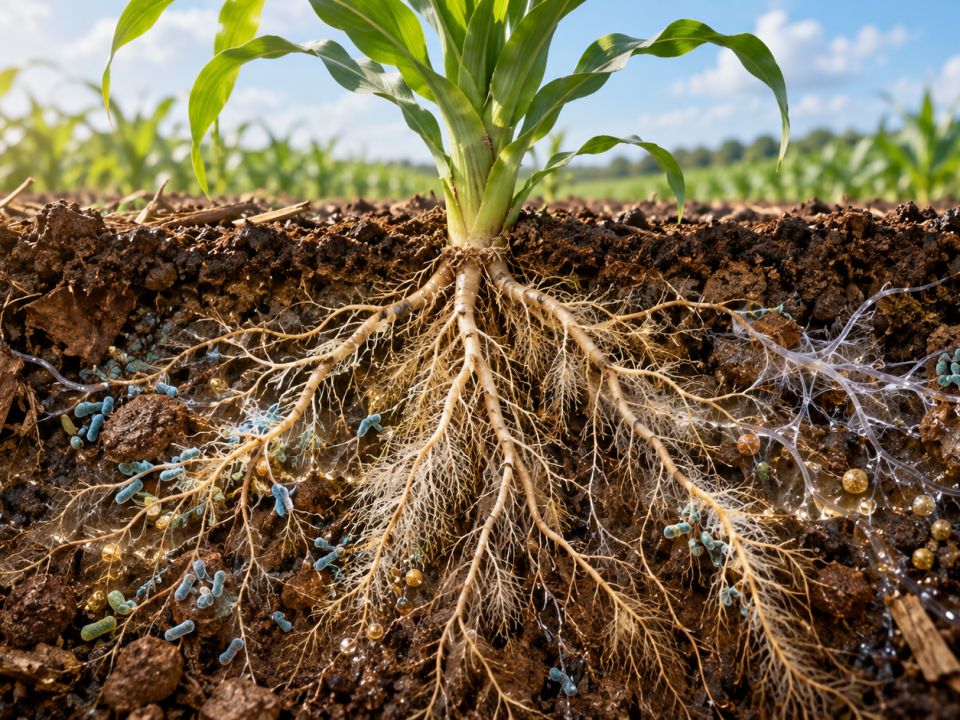
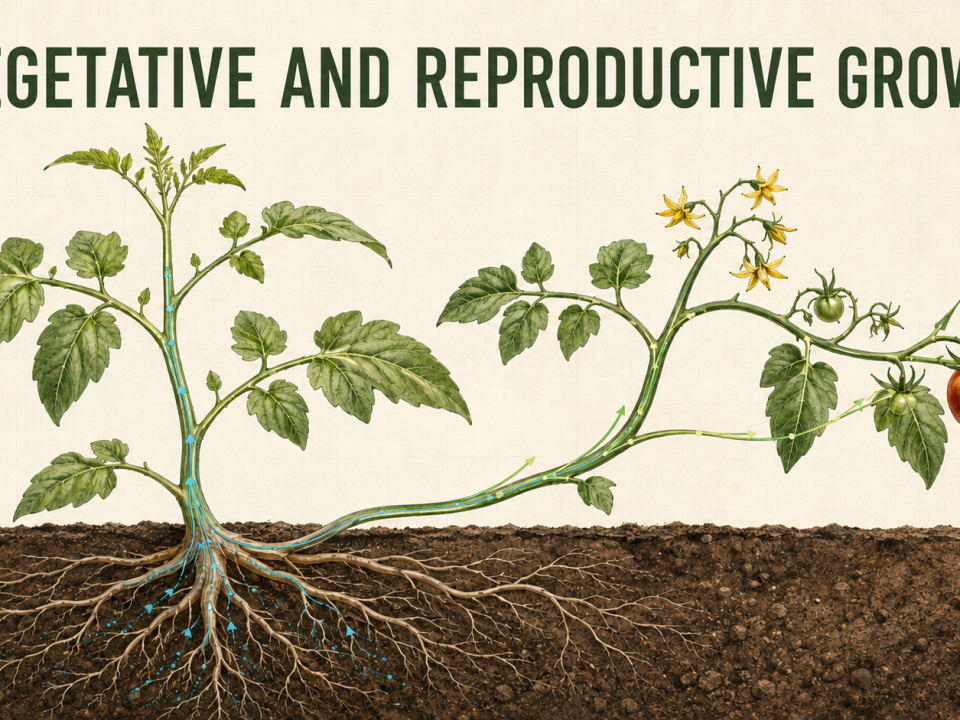
We can imagine the plant as a city connected by roads. The roots would be the entry point for water and minerals; the leaves, the factories where sugars are produced through photosynthesis; and the fruits, large consumption centres that need to receive materials constantly in order to grow.
During this process, the plant decides which organs receive more resources, where they are mobilised from and how quickly they are transported. This regulation changes continuously according to the stage of development, environmental conditions and the nutritional status of the crop.
Source organs and sink organs
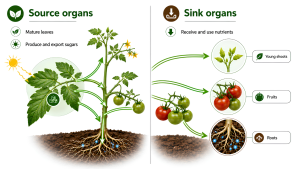
To understand how nutrients are redistributed, it is necessary to distinguish between source organs and sink organs.
Source organs are those parts of the plant that produce or release more resources than they need to maintain themselves. Mature leaves are the main source of sugars, as they transform light, water and carbon dioxide into organic compounds through photosynthesis.
Other storage organs, such as stems, roots, tubers or woody tissues, can also act as sources, especially when they mobilise substances that had previously been stored.
Sink organs, by contrast, consume or store the resources they receive. Growing fruits are one of the plant’s most important sinks, but young roots, new shoots, flowers and seeds also act as sinks.
The relationship between source and sink can be visualised as a network of factories and warehouses. The leaves manufacture sugars, while the fruits receive, transform and accumulate them. The greater the fruit’s ability to attract these compounds, the stronger it is as a sink.
This strength depends on factors such as the number of cells, the metabolic activity of the tissue, hormone production and the fruit’s capacity to unload and rapidly use the nutrients it receives.
The phloem: the main pathway to the fruit
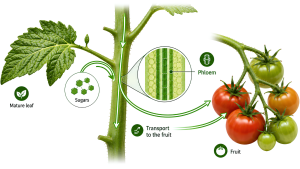
Most of the sugars produced in the leaves are transported to the fruits through the phloem.
The phloem is a vascular tissue formed by specialised cells that run through the plant from the leaves to the developing organs. Its functioning can be compared to a network of pressurised pipes.
In mature leaves, the sucrose produced during photosynthesis is loaded into the phloem vessels. The high sugar concentration attracts water into these vessels, generating internal pressure. This pressure pushes the elaborated sap towards the areas where sugars are consumed or stored.
When the sap reaches the fruit, the sucrose is unloaded from the vessels and enters the cells. There, it can be used immediately to obtain energy, converted into other sugars, stored as starch or used in the formation of cell walls and new tissues.
Phloem movement does not work like a pump with a single fixed direction. Its orientation depends on the location of sources and sinks. For this reason, one leaf can send compounds towards a nearby fruit, while another part of the plant directs its resources towards roots or shoots.
Proximity also has an influence. Generally, leaves located near a fruit make an important contribution to its nutrition, although the architecture of each species determines the preferred transport routes.
The xylem: water and minerals from the root
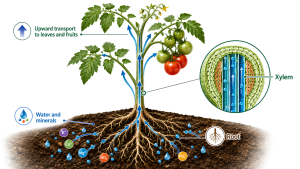
The second major transport system is the xylem. Its main function is to conduct water and mineral elements absorbed by the roots towards the aerial part of the plant.
This movement is driven mainly by transpiration. When leaves lose water through the stomata, a tension is generated that pulls the column of water contained in the xylem. In this way, water rises from the soil as if it were a continuous rope under tension.
In the early stages of fruit development, the xylem usually plays an important role. The fruit undergoes intense cell division and needs water, calcium, nitrates, potassium and other elements to build new tissues.
However, as some fruits ripen, their functional connection with the xylem may decrease. In certain species, an increasing proportion of water and nutrients then arrives associated with the phloem flow.
This change has important nutritional consequences. Elements with low mobility in the phloem, such as calcium, depend largely on supply through the xylem. For this reason, localised deficiencies can appear in the fruit even when the soil contains sufficient calcium.
The problem is not always the total amount available, but the plant’s ability to transport it to the tissue that needs it.
First stage: cell division
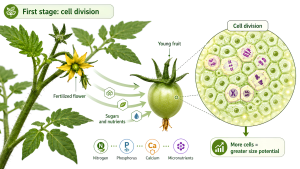
After fertilisation, the fruit begins a stage of intense cell division. During this period, the number of cells the fruit will have is largely determined.
We can imagine a small newly formed fruit as a building that is still defining the number of rooms it will contain. Later, those rooms may expand, but if too few are built at the beginning, the final size potential will be more limited.
During this stage, the fruit demands nitrogen to synthesise proteins, phosphorus for energy processes and nucleic acid formation, calcium to build membranes and cell walls, and micronutrients involved in enzymatic activity.
It also needs a constant supply of sugars, not only as structural material, but also as an energy source to sustain rapid cell multiplication.
Plant hormones, such as auxins, cytokinins and gibberellins, are involved in regulating this process. These signals help reinforce the young fruit’s capacity to act as a sink and attract resources from other parts of the plant.
Second stage: fruit expansion and filling
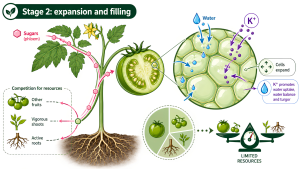
Once the number of cells has been established, a stage dominated by their expansion begins. The cells absorb water, accumulate solutes and increase considerably in volume.
Visually speaking, the fruit moves from building new rooms to inflating and filling the ones that already exist.
During this stage, potassium becomes especially important. This element participates in osmotic regulation, control of water balance and numerous enzymatic processes. By favouring solute accumulation in the cells, it helps draw water inside and maintain the turgor pressure required for expansion.
Sugars continue to arrive from the leaves through the phloem. Some of them are used in cellular respiration, while another part accumulates or is transformed into starch, organic acids and different structural compounds.
At this point, the fruit competes with other sinks. If there are too many fruits, vigorous shoots or actively growing roots, the availability of resources for each organ may decrease.
It is like distributing a limited amount of food among a growing number of diners. The more active sinks there are, the greater the competition, unless photosynthetic activity and root absorption increase in the same proportion.
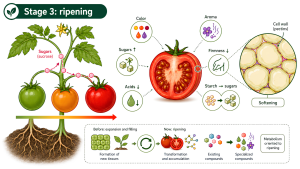
Third stage: ripening
During ripening, the fruit undergoes profound changes in its composition. Colour, firmness, aroma, acidity and sugar content evolve until they reach the characteristics typical of each species and variety.
In some fruits, the starch accumulated during previous stages is transformed into simple sugars. In others, the direct import of sucrose from the leaves increases.
Changes also occur in the cell walls. Pectins and other structural components are reorganised, causing progressive softening of the tissue.
At the same time, certain organic acids decrease, pigments such as anthocyanins or carotenoids are synthesised and numerous volatile compounds responsible for aroma are formed.
At this stage, the plant does not simply send more nutrients to the fruit. It also changes the way in which those nutrients are used. Metabolism becomes less oriented towards creating new tissues and more towards the accumulation, transformation and specialisation of compounds already present.
Nutrient mobility within the plant
Not all nutrients can be redistributed with the same ease.
Elements such as nitrogen, phosphorus, potassium and magnesium have relatively high mobility. When they are in short supply, the plant can extract them from old leaves and move them towards young organs or developing fruits.
This process resembles emptying an old warehouse to supply a priority area. As a result, deficiency symptoms usually appear first on the older leaves.
Calcium, however, has very low mobility in the phloem. Once deposited in a tissue, it is difficult to move it to another. For this reason, calcium deficiencies usually appear in young leaves, meristems or fruits, even when other parts of the plant contain sufficient quantities.
Boron also has limited mobility in many species, although this behaviour may vary depending on the plant’s capacity to produce certain sugar alcohols.
These differences explain why the overall analysis of a plant does not always accurately reflect the nutritional status of the fruit. The key is not only how much nutrient the crop contains, but where it is located and whether it can reach the target organ at the right time.
Competition between fruits, leaves and shoots
The distribution of resources within the plant is dynamic. A fruit does not receive nutrients automatically: it must compete with other active organs.
A very vigorous vegetative shoot can become a strong sink and capture sugars, nitrogen and minerals that, under other circumstances, could be directed towards the fruits.
Similarly, an excessive fruit load can reduce individual calibre, delay ripening or decrease sugar accumulation.
The plant adjusts this distribution through hormonal signals, changes in metabolic activity and modifications in the conductivity of vascular tissues.
Agronomic practices directly influence this balance. Pruning, fruit thinning, irrigation management, fertilisation and the control of vegetative vigour modify the relationship between sources and sinks.
For example, moderate thinning reduces the number of competing fruits and allows each one to receive a greater proportion of the available resources. However, excessive removal can also alter the vegetative balance and stimulate overly vigorous shoot growth.
The role of water in redistribution
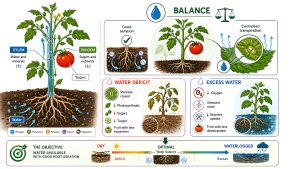
Water is the vehicle in which most nutrients move. Without adequate water circulation, root absorption decreases and transport through the xylem and phloem is affected.
Moderate water deficit causes stomatal closure, reduces photosynthesis and limits sugar production. If the stress continues, the turgor pressure of the cells decreases and fruit expansion slows down.
However, excess water can also be problematic. Saturated soils contain less oxygen, which hinders root respiration and reduces their capacity to absorb nutrients.
Water management must therefore seek a balance. The objective is not to keep the soil permanently waterlogged, but to ensure water availability compatible with good root aeration and controlled transpiration.
Environmental stress and nutrient transport
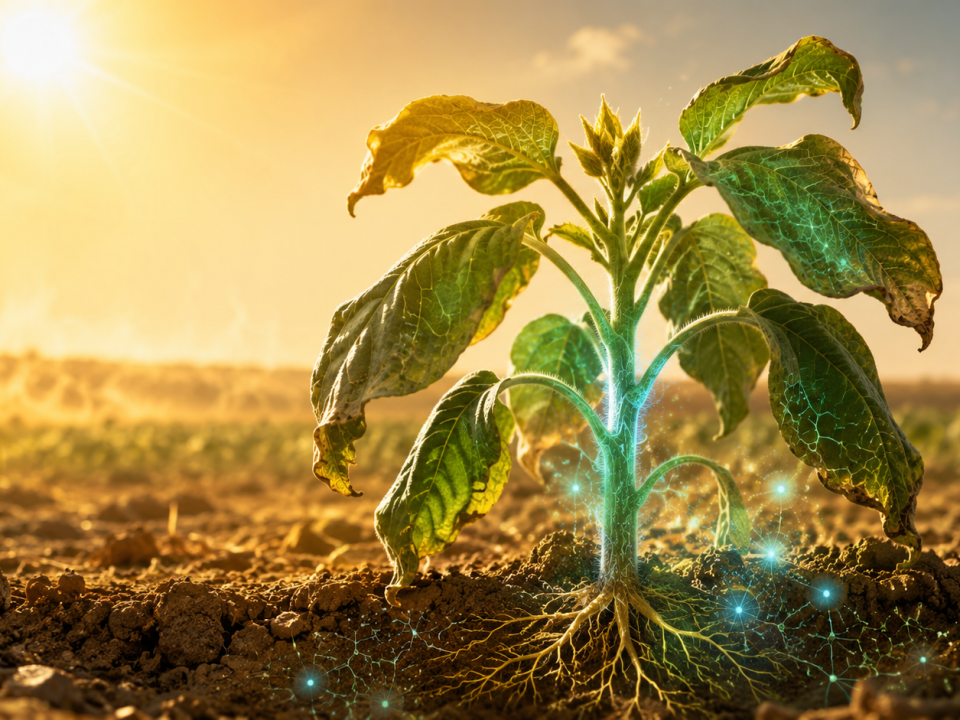
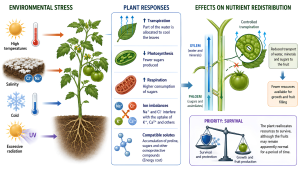
High temperatures, salinity, cold or excessive radiation can alter the internal redistribution of nutrients.
When the temperature is too high, the plant increases transpiration and may allocate more water to cooling the leaves. At the same time, respiration consumes an increasing proportion of the sugars produced, reducing the amount available for the fruit.
Salinity makes it more difficult for water to enter the roots and can cause imbalances between ions. Sodium and chloride, for example, can interfere with the absorption of potassium, calcium and other essential elements.
In stress situations, the plant also accumulates compatible molecules, such as proline, soluble sugars and other osmoprotective compounds. These substances help maintain cellular balance, but their production consumes energy and carbon that could otherwise have been used for growth.
For this reason, a crop under stress may maintain apparently normal fruits for a time, even though internally it is modifying resource allocation to prioritise survival.
Continuous coordination
Nutrient redistribution during fruit development is not a linear or automatic process. It is a continuous coordination between root absorption, photosynthetic activity in the leaves, vascular transport and the metabolic demand of each organ.
In the early stages, the fruit needs materials to divide cells and build tissues. Later, the demand for water, potassium and sugars increases in order to expand and fill. During ripening, nutrients are transformed and reorganised to define the colour, texture, flavour and final quality.
Understanding this functioning makes it easier to interpret many agronomic problems. A small fruit does not always indicate a lack of fertiliser. It may be due to low photosynthetic activity, excessive crop load, a transport problem, a poorly functional root system or intense competition with shoots.
Effective plant nutrition does not consist solely of supplying elements to the soil or the leaves. It also involves favouring those elements being absorbed, transported and used in the right organ, in the necessary amount and at the precise moment.
Ultimately, every fruit is the result of a complex internal negotiation. While the leaves capture energy, the roots explore the soil and the conducting vessels connect the entire structure, the plant redistributes its resources to complete one of its most demanding processes: transforming a small fertilised flower into a fully developed fruit.
Productos relacionados