

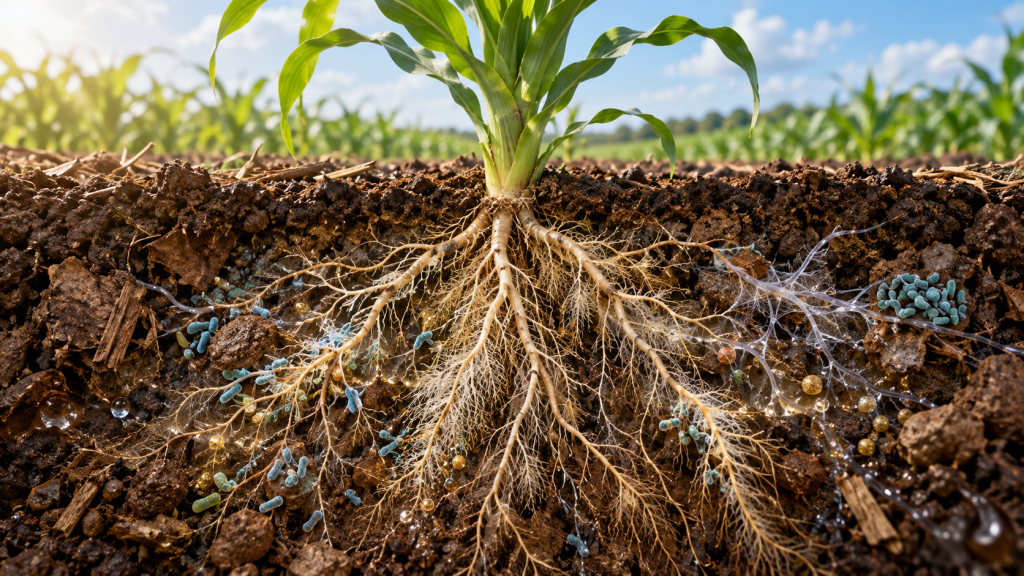
When analysing the nutritional status of a crop, it is common to focus on the amount of nutrients supplied through fertilisers. However, plant nutrition does not depend solely on the composition or dose of the products applied. For a plant to use these nutrients correctly, it needs an active root system and must develop in soil with suitable physical, chemical and microbiological conditions.
The root system, soil microbiology and plant nutrition therefore form a closely interconnected system. If any of these three elements does not function correctly, the efficiency of the nutritional programme may be limited, even if the nutrients are present in the soil.
Understanding this relationship makes it possible to design more efficient fertilisation strategies, improve the use of resources and favour more balanced crop development.
The root system: the basis of plant nutrition
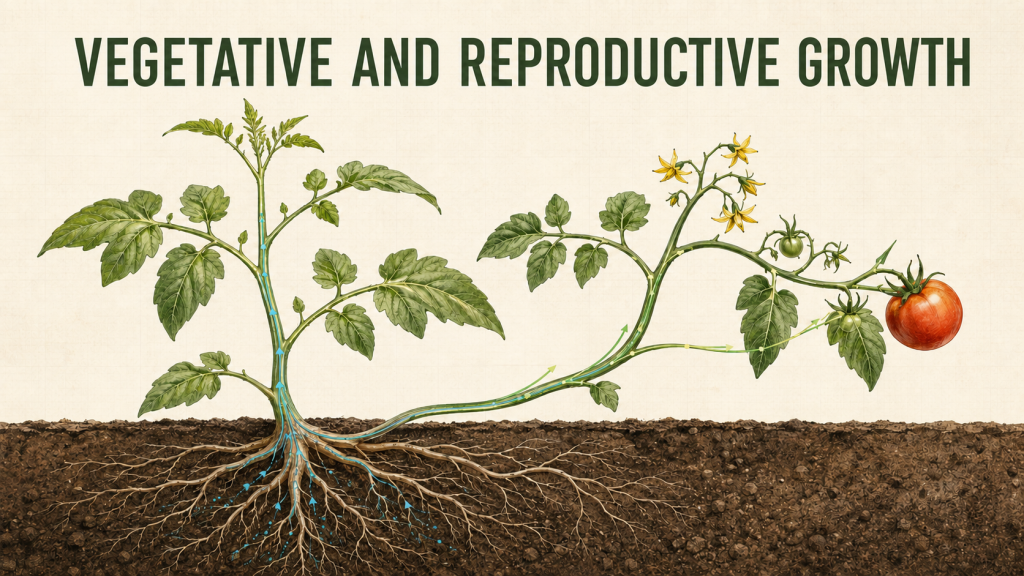
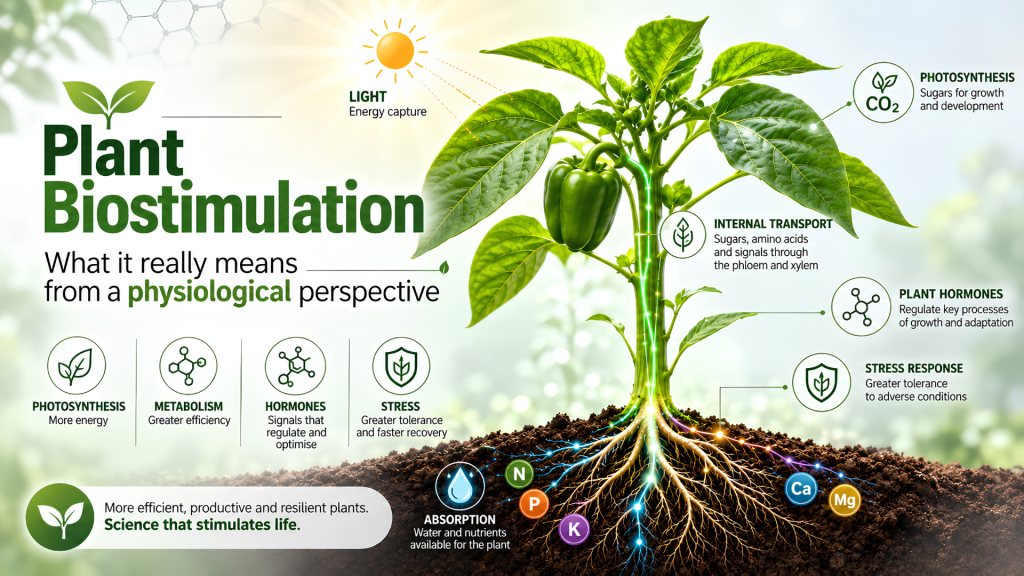
Roots perform many more functions than simply anchoring the plant to the soil. They are responsible for absorbing water and nutrients, storing reserves and establishing constant communication with the environment around them.
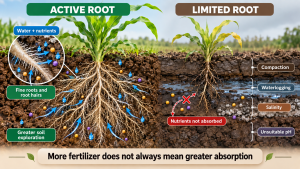
Most mineral nutrients are absorbed as ions dissolved in the soil solution. For this process to take place, the roots must be active and have sufficient fine roots and root hairs, which are the structures that provide the greatest contact surface with the soil.
A healthy, well-branched root system allows the plant to explore a greater volume of soil. This facilitates access to water and nutrients, especially those with low mobility, such as phosphorus and some micronutrients.
By contrast, factors such as compaction, waterlogging, salinity, extreme temperatures, high electrical conductivity or unsuitable pH can reduce root activity. When this occurs, the plant may show deficiency symptoms even though the soil contains a sufficient amount of the affected nutrient.
This explains why increasing the fertiliser dose does not always solve a nutritional problem. In some cases, the real limiting factor is not the amount of nutrients available, but the root system’s inability to access or absorb them.
The rhizosphere: the meeting point between root and soil
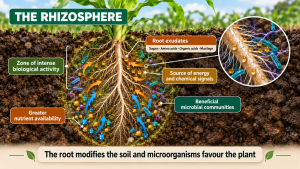
The area of soil directly influenced by the roots is known as the rhizosphere. Although it occupies a relatively small space, it has intense biological activity and plays a fundamental role in plant nutrition.
Roots release different substances into the soil, known as root exudates. These include sugars, amino acids, organic acids, mucilage and other compounds derived from plant activity. These substances can act as an energy source or as chemical signals for the microorganisms present around the root.
As a result, the plant does not interact with all soil microorganisms in the same way. Through its exudates, it can favour the presence of certain microbial communities capable of developing close to the root and establishing beneficial relationships with it.
The rhizosphere therefore functions as a dynamic environment in which the root modifies soil conditions and, at the same time, microorganisms influence nutrient availability and plant development.
How does soil microbiology influence plant nutrition?
Soil hosts an enormous diversity of bacteria, fungi and other microorganisms. They do not all perform the same functions, nor are they all beneficial for crops. However, certain microbial communities can actively participate in processes that are essential for soil fertility.
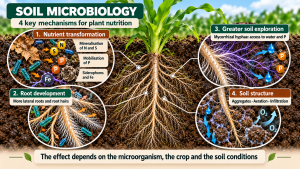
Transformation and availability of nutrients
Some nutrients are found in compounds that roots cannot absorb directly. Certain microorganisms are involved in the decomposition of organic matter and in the transformation of these nutrients into forms that are more available to the plant.
This process is especially important in the mineralisation of nitrogen, sulphur and other elements associated with organic matter.
Other microorganisms can contribute to solubilising certain phosphorus compounds through the production of organic acids and other substances. This does not mean that they generate new phosphorus, but that they can help mobilise part of the phosphorus already present in the soil, which remains in poorly accessible forms.
There are also microorganisms capable of producing siderophores, molecules that capture iron from the environment. Depending on the microorganism, the crop and the soil conditions, these processes can influence iron availability in the rhizosphere.
Root system development
Some beneficial bacteria associated with roots can produce or modulate substances related to plant growth. This interaction can favour the formation of lateral roots and root hairs, increasing the exploration surface of the root system.
The potential result is a root that is better prepared to access the available resources. However, the response will depend on factors such as the microbial strain used, soil type, crop, temperature, moisture and application timing.
Exploration of a greater volume of soil
Mycorrhizal fungi establish an association with roots and develop a network of hyphae that can extend beyond the area directly explored by root hairs.
This network expands contact with the soil and can improve access to water and low-mobility nutrients, especially phosphorus. The effectiveness of this relationship depends on compatibility between the microorganism, the plant and the crop management conditions.
Soil structure and stability
Certain microorganisms produce extracellular substances that favour the binding of soil particles. Together with the action of roots and fungi, this can contribute to the formation of more stable aggregates.
Good structure facilitates aeration, water infiltration and root growth. Therefore, microbiological activity can also indirectly influence plant nutrition by creating a physical environment that is more favourable for root development.
Plant nutrition: supplying fertilisers is not enough
Plant nutrition products provide essential nutrients for crop development. However, their effectiveness is conditioned by many factors: pH, moisture, temperature, aeration, soil texture, salinity, root activity and the presence of functional microorganisms.
For example, a nutrient may be present but remain blocked by unsuitable pH. It may also move out of reach of the roots, precipitate with other elements or not be absorbed due to a damaged root system.
For this reason, an efficient nutritional strategy must consider not only how much nutrient is applied, but also:
- In what form that nutrient is found.
- Whether it can remain available in the soil.
- Whether the roots are prepared to absorb it.
- Whether there is sufficient water and oxygen.
- What interactions may occur with other nutrients.
- How the microbiology present in the rhizosphere influences it.
The objective is not only to increase inputs, but to ensure that a greater proportion of the available nutrients can be used by the plant.
The combination of nutritional products and microbiological solutions
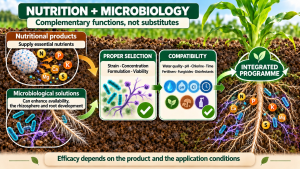
Fertilisers, biostimulants and microbiological products should not necessarily be understood as substitute tools. In many programmes, they can perform complementary functions.
Plant nutrition products supply elements required for plant metabolism. Microbiological solutions, in turn, can contribute to improving certain processes related to nutrient availability, rhizosphere activity or root development.
To make the most of this complementarity, products must be selected correctly and used according to their function. Not all microorganisms have the same capacities, and a microbial species alone does not guarantee a specific result. Efficacy depends on the strain, its concentration, the formulation, microorganism viability and application conditions.
It is also important to check the compatibility of microbiological products with fertilisers, fungicides, disinfectants and treatments that may affect microorganism viability. Water quality, mixture pH, the presence of chlorine and the time elapsed between preparation and application can be decisive.
How can the relationship between root, soil and nutrition be improved?
Before establishing a plant nutrition programme, it is advisable to carry out a diagnosis that includes, where possible, soil, water and plant material analyses. This information makes it possible to detect imbalances, salinity problems, nutritional blockages or conditions that may limit root activity.
It is also advisable to observe the roots directly. Their colour, distribution, branching and proportion of fine roots provide information that cannot always be obtained by analysing only the aerial part of the plant.
Based on this diagnosis, an integrated strategy can be proposed, based on:
- Correcting the physical or chemical factors that limit root growth.
- Adjusting nutrition to the crop’s real needs and phenological stage.
- Maintaining adequate moisture levels without causing oxygen deficiency.
- Selecting nutritional products with appropriate forms and application methods.
- Incorporating microbiological solutions when they are compatible with the crop and management system.
- Evaluating the response through agronomic indicators, foliar analyses and production results.
An integrated approach for more efficient crops
Plant nutrition begins long before the nutrient enters the plant. It begins in soil capable of storing it and keeping it available, continues in a biologically active rhizosphere and is completed through a root system prepared to absorb it.
For this reason, root, microbiology and nutrition must be managed as parts of the same system. Soil with functional microbiology can favour certain nutritional processes, but it needs suitable conditions to maintain this activity. Likewise, a good nutritional product will reach its maximum potential when applied to a crop with active and properly developed roots.
When looking for plant nutrition products or solutions aimed at improving the biological functionality of the soil, the first step should be to study the characteristics of the crop, water quality, root condition and plot conditions.
At BIAGRO, we develop plant nutrition programmes and microbiological solutions adapted to the needs of each crop. Our technical team can help you define a specific strategy to improve the relationship between soil, root and plant, optimising nutrient use and the efficiency of the agronomic programme.
Productos relacionados