

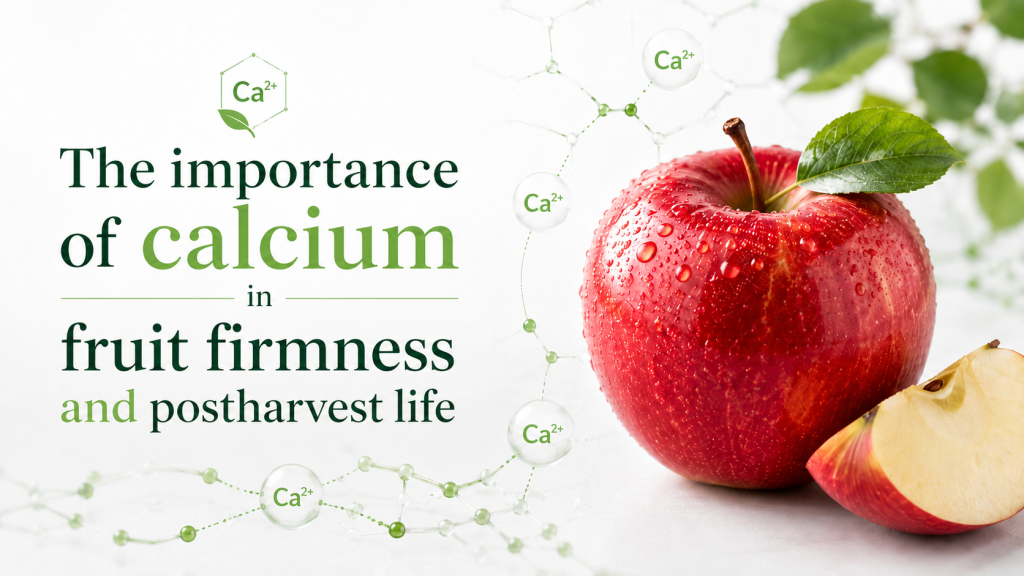
In agriculture, talking about calcium means talking about quality. Although it is often associated solely with correcting deficiencies, calcium performs a much broader function within the plant: it participates in tissue formation, cellular stability, fruit firmness and post-harvest storage capacity.
For horticultural crops, fruit trees, citrus fruit, berries or vines, correct calcium nutrition can make the difference between a fruit with good commercial suitability and one that is more sensitive to cracking, loss of firmness, rots or damage during handling.
From a physiological point of view, calcium forms part of cell walls by binding with pectins, generating structures known as calcium pectates. These bonds help provide cohesion to plant tissues and contribute directly to the mechanical resistance of the fruit. Various studies link the presence of calcium in the cell wall with greater firmness during post-harvest storage.
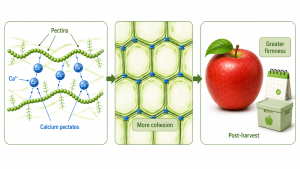
Why does calcium influence fruit firmness?
During fruit development, cells divide, expand and accumulate water, sugars and structural compounds. In this process, calcium acts as a stabilising element. Its presence helps reinforce the cell wall and maintain membrane integrity.
When the fruit has a good calcium level, tissues usually show:
- Greater firmness.
- Lower sensitivity to cracking.
- Better resistance to impacts and handling.
- Lower loss of quality during transport and storage.
- Better post-harvest performance.
By contrast, when calcium availability is insufficient or its distribution within the plant is not adequate, tissues become weaker. This can favour the appearance of physiological disorders such as blossom end rot in tomato and pepper, bitter pit in apple, tip burn in young leaves, apical necrosis, cracking or premature loss of firmness. Low calcium availability in fruit is considered a key factor in disorders such as blossom end rot and bitter pit.
Calcium and post-harvest shelf life: a direct relationship
Post-harvest shelf life does not begin in the warehouse; it begins in the field. A fruit that reaches harvest with balanced tissues, good cellular structure and adequate calcium levels has a clear advantage against softening, dehydration and deterioration processes.
Calcium helps delay the disorganisation of the cell wall, one of the processes associated with the softening of many fruits during storage. It also contributes to maintaining membrane integrity, which can reduce water loss and sensitivity to external damage. Post-harvest calcium treatments have shown positive effects in maintaining firmness and reducing deterioration in different fruits, precisely due to their role in cell wall and membrane stability.
For this reason, calcium products for agriculture should not be understood only as a corrective solution, but as a preventive tool aimed at improving the commercial quality of the crop.
The major challenge: getting calcium to the fruit
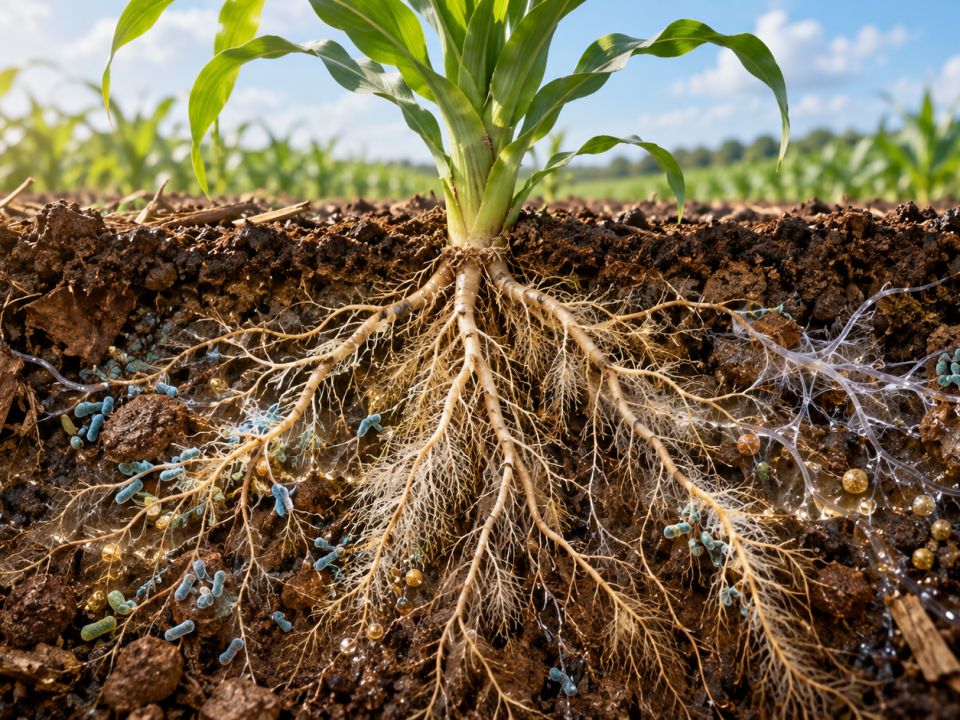
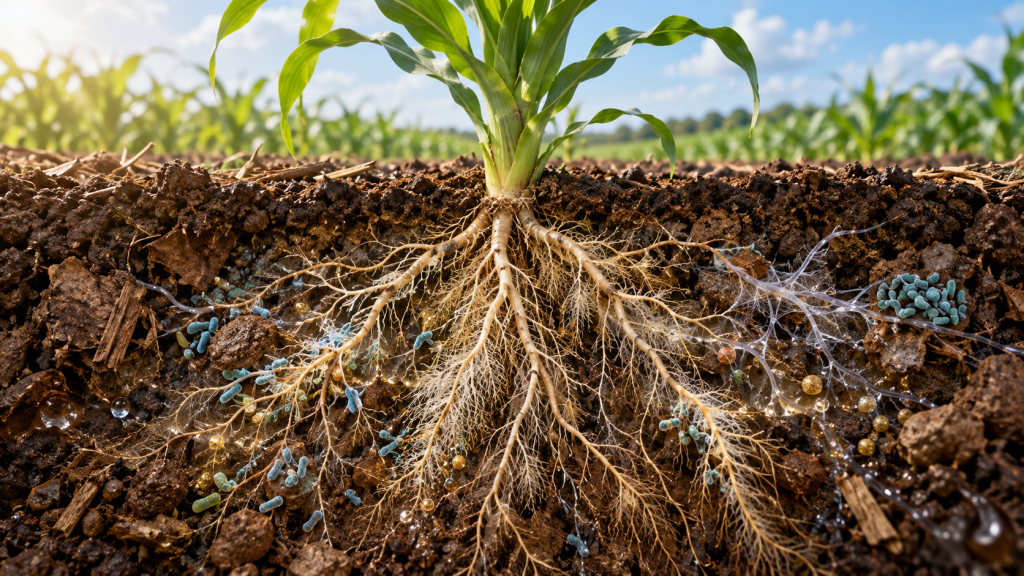
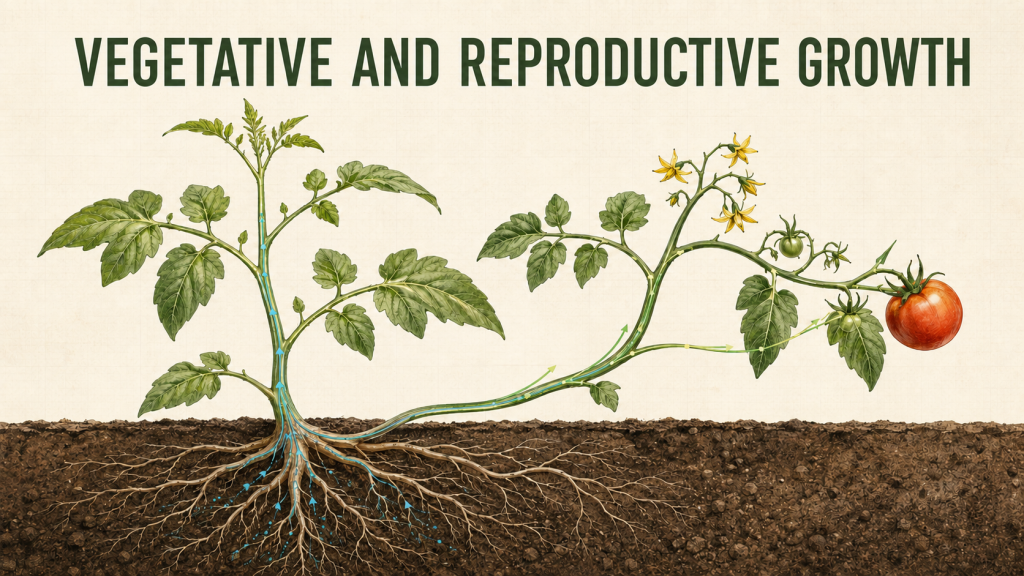
One of the main problems with calcium is its limited mobility within the plant. Unlike other nutrients, calcium is transported mainly through the xylem, following the transpiration flow. This means that organs with lower transpiration, such as fruit, flowers and young tissues, may receive less calcium even when the soil has sufficient levels.
This is one of the reasons why calcium problems can appear even in apparently well-fertilised plots. It is not always a question of how much calcium is available, but how much calcium the plant is actually able to absorb, transport and use.
Factors such as water stress, salinity, excessive vegetative vigour, high temperatures, poor irrigation management or imbalances with other cations can limit calcium movement to the fruit. For this reason, in nutrition programmes aimed at firmness and post-harvest performance, it is important to work with strategies that improve calcium absorption and distribution efficiency.
Complexed calcium: a technology to improve efficiency
In this context, complexed calcium formulations can provide an interesting agronomic advantage. Complexing helps keep calcium more stable and available, reducing blockage or precipitation phenomena that can limit its utilisation.
Within this type of solution is Calionix, developed by Biagro as a source of calcium complexed with heptagluconate and enriched with glycine betaine. Its composition includes 10% w/w water-soluble calcium oxide and 10% w/w calcium oxide complexed with heptagluconic acid, in addition to free L-amino acids and nitrogen. This technology seeks to improve calcium availability, absorption and mobility within the plant, favouring its use in organs with high physiological demand.
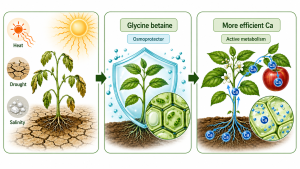
The presence of glycine betaine adds a complementary physiological component, as this molecule acts as an osmoprotectant and helps the plant maintain its metabolic activity under stress conditions such as heat, drought or salinity. In crops subjected to these situations, protecting plant function can be key to making calcium transport and use more efficient.
When is it advisable to apply calcium in agriculture?
Calcium applications are especially relevant during high-demand stages, such as active growth, flowering, fruit set, fruit enlargement and pre-harvest stages. They are also important when the commercial objective is to improve firmness, calibre, transport resistance or post-harvest shelf life.
In practical terms, a well-planned calcium strategy can be useful in:
- Tomato, pepper, aubergine and other horticultural crops sensitive to blossom end rot.
- Apple and pear trees, where post-harvest quality is decisive.
- Citrus fruit and fruit trees, to improve tissue consistency.
- Strawberry, berries and delicate fruits, where firmness determines marketability.
- Table grapes, where cracking and post-harvest shelf life are critical aspects.
However, calcium must be applied preventively. Waiting for visible symptoms to appear usually greatly reduces the margin for correction, because many calcium-related physiological disorders originate during the early stages of fruit development.
Conclusion: greater firmness, fewer losses and better commercial value
Calcium is one of the most important nutrients when the objective is to produce firm, resistant fruit with good post-harvest shelf life. Its role in the cell wall, membrane stability and the plant’s physiological response makes it an essential tool for improving the final quality of the harvest.
In an increasingly demanding market, where fruit must withstand handling, transport, storage and commercial display, efficient calcium nutrition can help reduce losses and increase the percentage of marketable production.
For this reason, calcium products for agriculture, especially those formulated to improve absorption and mobility, should form part of nutritional programmes aimed at quality, firmness and post-harvest preservation. Calionix fits into this line of work as a complexed calcium solution designed to favour better nutrient utilisation and support the final quality of the fruit.
Productos relacionados