
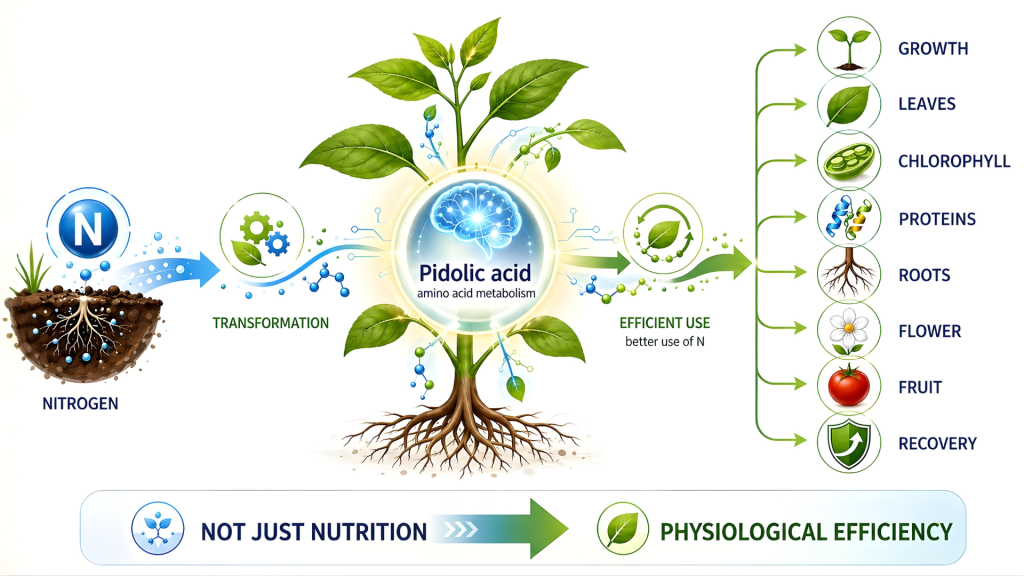
In agriculture, we often talk about nutrients: nitrogen, phosphorus, potassium, calcium, iron, zinc, boron… And, of course, all of them are important. But a plant does not function solely based on what it absorbs, but on how it uses all of this internally.
We could say that feeding the plant is one thing, while helping it make better use of that nutrition is something quite different. This is where certain special molecules come into play, such as pidolic acid.
Although its name may sound very technical, its function can be explained simply: pidolic acid helps the plant keep its metabolism active and balanced, especially when it is growing quickly or going through periods of stress.
What is pidolic acid?
Pidolic acid, also known as pyroglutamic acid, is a molecule related to amino acids. Amino acids are basic building blocks for plant life, as they take part in the formation of proteins, enzymes and many internal processes.
But pidolic acid is not just any amino acid. Its interest lies in the fact that it is connected to very important pathways in plant metabolism, especially those related to nitrogen use and energy production.
Put simply: it helps the plant work better from within.
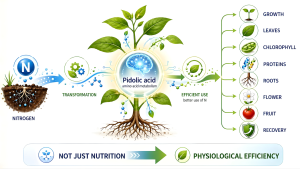
A helping hand to make better use of nitrogen
Nitrogen is one of the most important nutrients for any crop. It is involved in growth, leaf formation, chlorophyll production and protein synthesis.
But it is not enough for the plant simply to have nitrogen available. What matters is that it is able to transform and use it properly.
This is where pidolic acid plays an interesting role. As it is related to amino acid metabolism, it can help the plant manage that nitrogen more effectively and direct it towards useful processes: growth, recovery, flowering, fruit development or the formation of new roots.
That is why we are not talking only about nutrition, but about physiological efficiency.
Plants better prepared to face stress
Plants are exposed to many difficult situations: heat, cold, drought, excess water, transplanting, salinity, pruning, aggressive treatments or periods of heavy productive load.
When a plant suffers stress, its metabolism becomes unbalanced. It may reduce photosynthesis, lose energy, close its stomata, slow down growth or generate too much internal oxidation.
Pidolic acid helps the plant respond better to these situations. It does not prevent stress from occurring, but it can contribute to helping the plant manage it in a more balanced way.
It is like when a person is tired or under pressure: they cannot always eliminate the problem, but they can have better tools to deal with it.
Something similar happens in the plant. If its metabolism is better prepared, it can recover sooner and continue functioning with greater stability.
Keeping photosynthesis active
Photosynthesis is the plant’s engine. Thanks to it, the plant transforms light into energy and produces the sugars it needs to grow, flower and form fruit.
When there is stress, photosynthesis is usually one of the first functions to be affected. The plant slows down and, if the situation continues, productivity may be lost.
Pidolic acid is interesting because it helps keep this internal machinery more active. By supporting pathways related to amino acids, energy and cellular protection, it helps prevent the plant from “switching off” so easily under difficult conditions.
This is especially important at key moments in the crop cycle, such as transplanting, bud break, flowering, fruit set or fruit enlargement.
Support during recovery
One of the most valuable aspects of pidolic acid is its role in plant recovery.
After a period of stress, the crop needs to start up again. It needs to produce new cells, activate roots, recover leaves, mobilise nutrients and resume growth.
In this process, amino acids and the molecules related to them are essential. Pidolic acid helps make this recovery more efficient because it participates in pathways that connect nutrition, energy and metabolism.
That is why it makes sense to use it in products designed not only to feed the plant, but also to physiologically reactivate it.
Rhyzonix and pidolic acid: the brain of the product
This is where we can better understand the role of pidolic acid within Rhyzonix.
Rhyzonix is a product designed to support the plant during periods of high demand. It contains amino acids, organic nitrogen, zinc and boron, all of which are very important elements for growth, metabolic activity and crop development.
But within this formulation, pidolic acid plays a special role. We could say that it is the brain of the product.
Why? Because it does not act merely as another component, but as a molecule that helps coordinate the plant’s physiological response. While amino acids provide tools, nitrogen contributes to growth, zinc participates in enzymatic and hormonal processes, and boron helps with transport and development, pidolic acid brings coherence to the whole.
It helps the plant make better use of what it receives and transform it into activity: more energy, better response, greater balance and increased recovery capacity.
It is not just about nourishing, it is about activating
Today’s agriculture needs products that go beyond traditional nutrition. Crops are subject to more stress, greater production demands and increasingly variable climatic conditions.
That is why providing nutrients is important, but not always enough. We also need to help the plant use them better.
Pidolic acid represents this idea very well. It is a small molecule, but with a major role: helping the plant keep its metabolism active, balanced and ready to respond.
And that is why, within Rhyzonix, it becomes a key element. It is not simply a technical ingredient. It is the component that helps connect nutrition and physiology.
In short, pidolic acid helps the plant work better from within. And when a plant works better, it grows better, withstands stress better and produces better.
Productos relacionados